


Bus Fever Party!
4.11.14K Reviews
App Specs
- Version
- 1.2.9
- Updated On
- License
- Free
- Downloads
- 10,000,000+
- Developer
- Lumi Games
- Categories
- Casual
- Platform
- Android
Screenshots




 Analysis by AppCompare
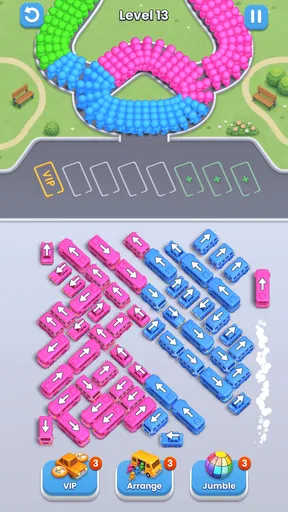
The first thing I like about Bus Fever Party! is how quickly its central idea makes sense: buses need to get out, but traffic is in the way. You look at a crowded parking layout, work out what is blocking the route, and try to clear a path. That makes it an easy casual game to understand before you have learned any complicated rules. The pleasure comes less from speed than from spotting the order in which vehicles need to move.
I would recommend it to someone who enjoys bite-sized traffic puzzles and wants a game that can be picked up without a long tutorial or a big time commitment. It is also a reasonable choice for a shared phone: the Everyone age rating makes it broadly suitable, and the basic premise is easy to explain to another player. Just go in expecting a focused puzzle rather than a deep driving game. The buses are the theme; the main challenge is reading the jam.
What the traffic puzzles ask of you
As a casual game from Lumi Games, Bus Fever Party! sits closer to a parking-brain teaser than to a conventional bus simulator. You are not being asked to master routes, manage a fleet, or steer through a city. Instead, the central task is to make useful moves in a cramped space. A vehicle that looks like the obvious first choice may be blocking another one, so a little planning matters more than quick reactions.
That distinction is worth knowing before installing. If you normally play casual games for short mental breaks, the board-based problem solving is a natural fit. If you want a racing game, a realistic transport sim, or a puzzle with a story that carries you through a long session, this is probably not the best match. Its appeal is the small, concrete question in front of you: what can move now, and what has to move first?
The game’s short “Bus Fever Party!” description captures the playful tone, but it does not tell a new player how to approach a puzzle. My practical advice is to pause briefly before making the first move. Trace the route you want the bus to take, then identify the vehicle that blocks that route most directly. This simple habit can prevent the common mistake of shifting whatever looks easiest and ending up with a more tangled layout.
Its place among casual puzzle games is specific. Compared with a word game, there is no vocabulary to retrieve; compared with a match-style game, there is no need to chase a chain of quick combinations. The challenge is spatial and sequential. That can feel refreshingly direct, though players who prefer puzzles with a wide variety of rules may eventually want a different game alongside it.
Getting started without overthinking it
There is no elaborate setup to explain before you can try the core idea. On Android, the listed minimum operating system is version 8.0, so it is worth checking your device’s software before downloading. The game is free to install, and it includes in-app purchases priced from $1.99 to $99.99 per item. I would treat the purchase option as something to review deliberately rather than assume you need it to understand the puzzle.
Worth Reading Before You Choose

Flipboard Shows What News Apps Must Do Beyond the Feed

Switching to Android Auto Means Rethinking Your Driving Routine

Google Calendar Makes a Crowded Week Easier to Manage

Ludo King Makes the Most of the Minutes Between Plans

Baby Panda World Brings Quick Play to Modern Phones, but Its Game Library Feels Busy

ESPN’s Live Game View Makes Following Close Games Easier
When you first open a level, focus on what the board actually lets you do instead of trying to guess at hidden rules. Look at the direction and position of each vehicle, notice which spaces are occupied, and work out where the target bus needs room. If a move does not immediately help, use it as information: it may reveal that a second vehicle is part of the blockage. The useful first goal is not to clear a whole run perfectly, but to make one move that clearly improves the route.
That first meaningful success is easier to recognize if you define it narrowly. Pick the vehicle that is directly preventing the bus from leaving, then ask whether moving it will open a usable space or merely shift the jam elsewhere. When a move creates the space needed for the next one, you have found the logic the game is asking you to use. I find this more reassuring than tapping at random, especially for anyone who worries that a puzzle game will demand trial-and-error from the start.
A good everyday scenario is a short break while waiting for a coffee or sitting on a bus. You can inspect a crowded layout, make a couple of deliberate moves, and put the phone away without needing to remember a complicated plot. If you are interrupted, the puzzle’s visible arrangement gives you a natural point to resume thinking. I would still avoid starting a particularly knotty board just before you need to leave; a simple-looking traffic jam can invite more thought than a quick glance suggests.
How to read a jam before moving
One non-obvious tip is to think in terms of bottlenecks rather than individual vehicles. The bus’s exit route may be blocked by one vehicle, but that vehicle may itself be trapped by another. Follow the chain backward: what must move first, and which space will it need? This way of reading the board is more reliable than clearing the most convenient open area, because every move has a purpose tied to the final route.
It also helps to separate a useful move from a merely possible one. A vehicle can have room to shift without that shift contributing to the exit. Before moving it, ask what new option the move creates. If the answer is “none that I can see,” hold off and inspect the board again. This is especially helpful when several vehicles are packed together and the first available move feels tempting simply because it is available.
A second useful habit is to preserve flexibility. If a move opens a space that could help more than one vehicle, it may be better than a move that solves only one small obstruction. In practical terms, look for spaces that function like temporary parking pockets. They can let a blocker get out of the way so another vehicle can pass. This is not a promise that every puzzle has a single elegant solution; it is a way to avoid using up the only helpful space too early.
When you get stuck, undoing or reconsidering your last decision is often more informative than continuing to move pieces without a plan. I would mentally retrace the sequence and find the point at which the board became less flexible. The important question is not simply “Which move was wrong?” but “Which open space did I need later?” That change in perspective turns a frustrating dead end into a clue about the order of operations.
Where first-time players may hesitate
The main source of confusion is that a traffic puzzle can look obvious while hiding a dependency. A bus may appear to have a clear route once one vehicle moves, yet that vehicle cannot move until another space opens. Resist the urge to interpret a crowded board as a reflex challenge. The game’s premise points toward planning, so a few seconds spent examining the layout are part of the play rather than wasted time.
Another point to keep in mind is that visual progress and useful progress are not always the same. Shifting several vehicles can make the board look different without bringing the bus closer to the exit. If your moves are multiplying but the route still seems blocked, stop and trace the path again from the bus outward. This is a concrete way to recover without blaming yourself or assuming the puzzle is asking for speed.
Because the game is free with optional purchases, it is sensible to pay attention to purchase prompts, particularly if a child is using the device. The age rating is Everyone, but that does not change the practical value of checking how purchases are handled on your phone. I would also make a personal rule before playing: enjoy the puzzle first, and only consider spending if you clearly understand what an item offers and genuinely want it. The listed item prices span a wide range, so casual curiosity is not a good reason to tap through a purchase.
For people comparing it with other familiar mobile puzzles, the trade-off is clear. A classic sliding-block game may feel more stripped down and purely logical; a match game may be better if you want bright, fast feedback with little planning. Bus Fever Party! gives the parking-jam idea a bus-focused goal, which makes each obstruction easy to visualize. The flip side is that anyone who dislikes spatial puzzles may find the central loop repetitive, even if the theme is appealing.
Who will enjoy it, and who may prefer something else
I think it works best for players who like to solve one small problem at a time, enjoy noticing dependencies, and do not mind slowing down to plan. It can suit a first-time puzzle player because the objective is intuitive: make room for the bus. It can also be a handy choice for a parent or sibling looking for a simple game to explain, provided the device’s purchase settings are appropriate for the person playing.
I would skip it if your ideal casual game depends on constant novelty, a strong narrative, social competition, or precise timing. This is not a substitute for a driving game if you want to steer a bus, nor for a management game if you want to build a transport network. Its narrower focus is a strength when you want an accessible traffic puzzle, but a limitation if you expect the bus theme to bring a full simulation with it.
The game has attracted over 10 million installs and holds an average rating of 4.2 from around 42,000 ratings, which suggests that many players have found the simple premise appealing. Those figures are useful context, not a guarantee that its particular style will suit you. For a first-time player, the better test is whether you enjoy looking at a blocked route and patiently working out the sequence that clears it.
What to try after your first clear
Once you have completed a puzzle, do not just repeat the same first-move instinct on the next one. Try scanning from the exit backward, then compare that with scanning from the most crowded cluster outward. This small change of method helps you notice whether the new challenge is mainly about a direct blocker or a chain of vehicles. It also gives you a way to improve without needing a timer or a score target to motivate you.
If you are playing on a phone in short sessions, leave yourself a clear mental note before putting it down: name the vehicle that currently blocks the route, or remember which space you are trying to free. That is more useful than remembering every move. On returning, you can rebuild the rest of the plan from the board. It is a practical approach for interruptions and keeps a casual puzzle from feeling like homework.
The current version is 1.2.6, and the game was released on April 23, 2025. Those details may help you identify the right title when browsing, but they do not change the central decision: whether you enjoy untangling a parking jam. Lumi Games has made a premise that is easy to grasp, and the strongest way to get value from it is to play thoughtfully rather than rush through the available moves.
My overall recommendation is cautious but positive. Bus Fever Party! is worth trying if a visual, bus-themed traffic puzzle sounds relaxing, and the free install makes it easy to see whether its style clicks with you. Go in expecting to plan vehicle movements, not to drive or manage buses. If you enjoy finding the one move that makes the next three possible, it can be a satisfying little break; if you want action or a broader range of puzzle mechanics, another casual game will likely hold your attention longer.
Pros
- Simple controls make it easy to pick up and play.
- Short levels suit quick gaming sessions.
- Bright visuals give the game a cheerful look.
- Traffic puzzles reward planning and careful timing.
- A lighthearted theme sets it apart from realistic driving games.
Cons
- Later puzzles can feel repetitive.
- Some levels may require several attempts to solve.
- The gameplay offers limited variety beyond traffic challenges.
- Ads may interrupt play
- depending on the version.
- Small on-screen elements can be tricky to see on phones.
FAQs for Bus Fever Party!
What is Bus Fever Party!?
Bus Fever Party! is a casual traffic and parking puzzle game built around moving colorful buses and passengers through crowded spaces. You generally need to choose a sensible order for the vehicles, clear paths, and match passengers with the right bus. Its straightforward controls make it approachable for quick sessions, while increasingly busy layouts add a planning challenge. The exact features and level selection can vary by game version.
How do you play Bus Fever Party!?
The main challenge is to manage buses and passengers without blocking the available routes. Tap or select vehicles to move them when the way is clear, and pay attention to passenger colors and the order in which buses can leave. A careless move may create a traffic jam, so look over the whole board before acting. Early stages usually introduce the rules gradually, with later puzzles demanding more careful planning.
Is Bus Fever Party! free to download and play?
Bus Fever Party! may be available as a free download, but availability, pricing, and included features can differ between the Google Play Store and Apple App Store, as well as by region. Free games may offer optional in-app purchases, advertisements, or both. Before installing, check the store listing for current pricing, purchase details, and any subscription information. If you prefer not to spend money, review your device’s purchase controls before playing.
Does Bus Fever Party! require an internet connection?
Whether you can play Bus Fever Party! offline depends on the current version and which features you want to use. Core puzzle levels may be playable without a connection, while advertisements, rewards, events, or other online services can require internet access. Check the game’s store description and test a level with your device offline if offline play matters to you. An internet connection may also be needed for updates or restoring certain purchases.
Is Bus Fever Party! suitable for children, and what should parents check?
The simple tap-based puzzles may be easy for many children to understand, but suitability depends on the child’s age and your family’s preferences. Before downloading, check the age rating and privacy details shown on the relevant app store. Also look for advertisements, in-app purchases, and any online features, since these can affect a child’s experience. Parents can use device-level purchase restrictions and screen-time settings where appropriate.


